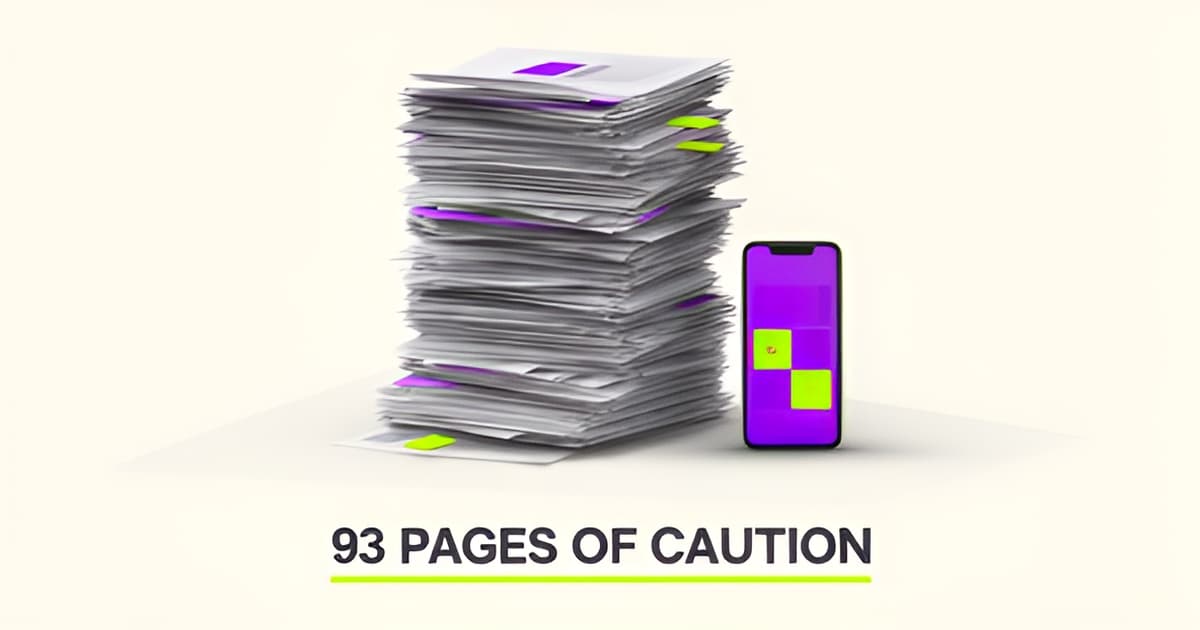
On Monday, October 26, Anthropic filed with the U.S. Securities and Exchange Commission to go public. According to CNN Business, whose report was carried by several regional affiliates, the AI lab's debut on Nasdaq under the ticker ANT could come as soon as November 16, 2026. Share count and price range are still unset, and the third-quarter numbers aren't in the document. The picture is still forming. What is already clear is the shape of the risk section, and it's the most unusual thing in the filing. While the reported valuation is as high as $2 trillion, Anthropic attached 93 pages explaining what could go wrong. That's roughly triple Snap's risk disclosure and nearly double Uber's. For a company whose founding premise was that advanced AI might pose an existential risk to humanity, that combination is worth paying attention to. So is the accounting, the timing, and what any of it means for the apps on your phone right now.
Key points
- Anthropic filed its IPO registration with the SEC on Monday, October 26, 2026, with trading on Nasdaq under the ticker ANT anticipated as soon as November 16, 2026. Share count and pricing haven't been disclosed yet.
- First-half 2026 revenue hit $16.3 billion, up 1,300% year over year, against a net loss above $80 billion. Roughly $72 billion of that loss was non-cash fair-value accounting, with actual compute and infrastructure spend just under $9 billion.
- The filing carries 93 pages of risk factors, against roughly 30 for Snap and 50 for Uber, covering model misuse, loss of human control, authoritarian abuse and surveillance, and economic disruption.
- Anthropic serves more than 14,000 enterprise customers, about 250 of which contribute $10 million or more annually, with revenue concentrated in the Claude product line. Its last private mark was $965 billion after a $65 billion raise in May 2026.
- OpenAI has reportedly pushed its own IPO to 2027, partly over safety concerns and debt-funded infrastructure spending, leaving Anthropic to take the first public-market test of frontier AI economics.
The headline figure is the one that travels fastest. Reports put the IPO valuation at up to $2 trillion, which would place Anthropic among the largest public companies in the world. That number comes from reporting rather than the filing itself, so treat it as a ceiling, not a confirmed mark. The last private valuation was $965 billion, set after a $65 billion raise in May 2026. The company serves more than 14,000 enterprise customers, and roughly 250 of them contribute $10 million or more each year. Revenue is concentrated in the Claude product line, which matters for anyone reading the filing as a signal about the broader AI market. One caveat on sourcing: the reporting so far traces back to a single CNN Business story syndicated across several local affiliates. The details are provisional until someone reads the registration statement end to end. Pricing terms are expected in the coming weeks, and the third quarter, which ended September 30, isn't included. Those two gaps are where the real story will land.
Anthropic's first-half 2026 numbers look alarming on a headline basis. Revenue of $16.3 billion, up 1,300% year over year, and a net loss of more than $80 billion. Read the second number carefully before you react to it. About $72 billion of that loss came from non-cash fair-value changes on convertible notes, derivatives and SAFEs. Actual infrastructure and compute spend was just under $9 billion. The difference between the two figures is the entire argument about whether frontier AI economics work at scale, and it's the part most summaries skip. There's a useful lesson here for anyone following AI spending claims generally. A reported loss and a cash burn are different animals, and companies that draw enormous capital often carry enormous paper losses on instruments issued during the private rounds. Dan Ives of Yorkville & Ives expects Anthropic's growth to outweigh investor concern about losses and risk. Jacob Bourne, an analyst at Emarketer, frames the IPO as a test of public scrutiny arriving at a moment when policymakers and the industry's own technologists are pressing hard on safety questions. Both positions can hold at once. The growth is real, and so is the risk section.
Most IPO risk sections are boilerplate you scroll past on the way to the projections. Anthropic's runs 93 pages and gets its own categories: misuse of models in bioweapons or cyberattacks, loss of human control, authoritarian abuse and surveillance, and economic disruption. The company also warns that harm caused by its models could exceed available insurance coverage, and that models may act in unintended or 'misaligned' ways without anyone directing them to. It acknowledges the bubble debate directly, naming slower-than-expected demand, compute constraints, regulatory uncertainty and revenue concentration as risks to the business. In most filings, disclosure is a legal formality. Here it reads like the company's thesis. A lab built on the premise that advanced AI could pose an existential risk is now asking public shareholders to hold it to that premise in a document that will be read by analysts, journalists and regulators. That's a strange thing to watch, and a somewhat admirable one. It's also a benchmark for smaller operators. If a frontier lab can lead with 93 pages of what might go wrong, a small app team leading with a beta label and honest verdicts has no excuse to be vague about what it's testing.
Timing is the quiet strategy here. OpenAI has reportedly delayed its own IPO to 2027, partly because of safety concerns and debt-fueled infrastructure spending. Anthropic is moving first, which means taking on public scrutiny before the market has settled on whether frontier AI business models hold up at scale. Going first has advantages. It sets the terms of the conversation, and it lets a company with a clean, safety-forward brand define the frame before anyone else does. It also means absorbing the first wave of volatility. If the IPO prices near the reported $2 trillion and then drifts, that becomes the reference point every other AI lab inherits. If it prices lower, the same applies in reverse. The missing third-quarter numbers are the swing factor. Anthropic is asking investors to price a company whose most recent complete quarter they haven't seen. The pricing terms, expected in coming weeks, will tell you how much of the reported valuation the market actually believes.
Here's where this touches you directly. Claude is a competitor-adjacent topic for anyone tracking AI companion and chat apps, and Anthropic's IPO cycle will push that category into the spotlight for the next several weeks. Expect more attention, and expect some of it to be sloppy. That's where an honest verdict earns its keep. When we cover a competitor, we say where it wins as plainly as where it loses, and we don't post ratings for something still in beta. FlirtAlly, our own app, sits squarely in that category. It stays pinned as 'Editor's app (beta)' in the second position of every grid, carries no ratings or reviews while it's in beta, and links straight to the waitlist at flirtally.com. Like, Apps is operated by the makers of FlirtAlly, and that disclosure sits in our footer and on our about page. A directory that won't tell you who runs it is asking for trust it hasn't earned. A $2 trillion IPO validates the AI ecosystem and, at the same time, marks the point where the bubble question stops being theoretical. Both can be true at once. Either way, the apps on your phone don't get replaced by a ticker. They get picked, one download at a time, and that's a job a directory does better than a stock symbol.
Anthropic has done something unusual here. It filed a document that puts the upside and the downside in the same breath: a reported $2 trillion ceiling, 1,300% revenue growth, and 93 pages of warnings about the company's own technology. The valuation is reported rather than confirmed, pricing is still weeks away, and the third quarter is missing from the filing. The first trading day could be less than three weeks out. Watch the pricing terms, then read the risk section, because that's where the company explains what it thinks it's building and what might go wrong. In the meantime, keep an eye on the AI companion apps in your own feed. The next one you download deserves a verdict from someone who actually tried it.